Implement CSRF Protection
Introduction
Cross-Site Request Forgery (CSRF) is an attack that forces an end user to execute unwanted actions on a web application in which they’re authenticated.
UPDATE
CSRF protection is no longer required in frontend projects. We have migrated from Next.js Routes to Server Actions.
Related discussion: https://github.com/PHPCreation/phpreaction-frontend-login-react/issues/398
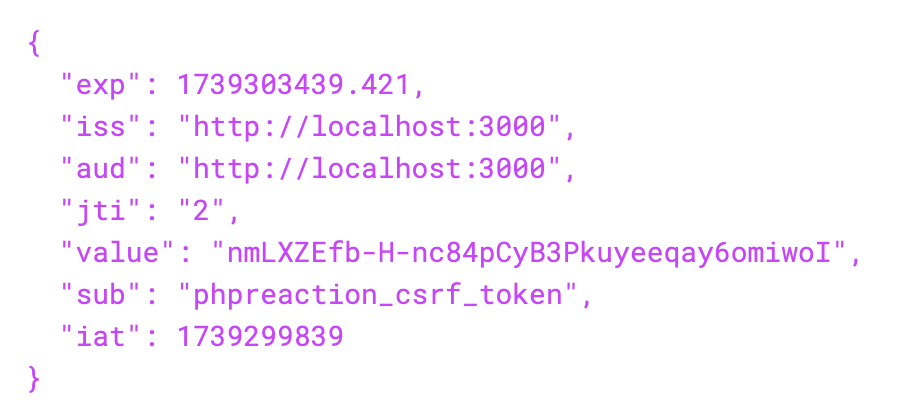
Structure of a JWT-CSRF token
{
  "exp": 1739422155, // The expiration time of the token
  "iss": "http://demo.dev.inventory.phpr.link/fr/product", // The issuer of the token
  "aud": "http://demo.dev.inventory.phpr.link/fr/product", // The audience of the token
  "jti": "be6f7cbc-8a20-43ce-944d-3927e63c62ac", // Unique identifier for the token
  "value": "cAqJ8hfM-8GiIeE9a374bb_0PbqkrvZw9qKE", // CSRF token
  "sub": "phpreaction_csrf_token", // The subject of the token
  "iat": 1739378955 // The time the token was issued
}
Cookie storage
The CSRF secret and the CSRF token are stored in two separate cookies, both signed as JWTs:
csrfSecret: JWT holding the CSRF secret (sub: "phpreaction_secret_token")csrfToken: JWT holding the CSRF token value (sub: "phpreaction_csrf_token")
Both cookies are set as:
HttpOnly: not accessible via client-side JavaScript, mitigating token theft through XSSSecure: only sent over HTTPSSameSite=Lax

They are stored as JWTs :
How the JWTs are generated
export function generateCSRFToken(response: Response, url: string) {
  const secret = csrfInstance.secretSync();
  const csrf = csrfInstance.create(secret);
  const commonPayload = {
    exp: Date.now() / 1000 + 60 * 60,
    iss: url,
    aud: url,
  };

  const secretToken = sign(
    {
      ...commonPayload,
      jti: "1",
      value: secret,
      sub: "phpreaction_secret_token",
    },
    process.env.NEXT_PUBLIC_APP_SECRET
  );

  const csrfToken = sign(
    {
      ...commonPayload,
      jti: "2",
      value: csrf,
      sub: "phpreaction_csrf_token",
    },
    process.env.NEXT_PUBLIC_APP_SECRET
  );

  response.headers.append(
    "Set-Cookie",
    `csrfSecret=${secretToken}; HttpOnly; Secure; Path=/; SameSite=Lax`
  );

  response.headers.append(
    "Set-Cookie",
    `csrfToken=${csrfToken}; HttpOnly; Secure; Path=/; SameSite=Lax`
  );

  return csrfToken;
}
How to protect your app from CSRF
In api folder
Create a folder csrf
Create a get csrf token file : /api/csrf/get-csrf-token/index.ts
This will be used to get the CSRF token.
Import the getCsrfToken function from the utils bundle, which will handle the fetch process of the CSRF token
import { getCsrfToken } from "@phpcreation/frontend-utils-react-nextjs-bundle/api-functions";

export async function GET(request: Request) {
  return getCsrfToken(request);
}
It will :
- Generate the CSRF token
- Verify (and decode) the CSRF token
- Return the decoded CSRF token
import { generateCsrfToken, verifyCsrfJwt } from "utils/functions";
import { getFromCookie } from "utils/helpers";

export default function getCsrfToken(request: Request): Response {
  const response = new Response();

  let token = getFromCookie(request, "csrfToken");

  if (!token) {
    token = generateCsrfToken(response, request.headers.get("referer") || "");
  } else {
    try {
      verifyCsrfJwt(token);
    } catch (error) {
      if (error.name === "TokenExpiredError") {
        token = generateCsrfToken(
          response,
          request.headers.get("referer") || "",
        );
      }
    }
  }

  let decodedCsrfJwt = verifyCsrfJwt(token);

  return new Response(JSON.stringify(decodedCsrfJwt), {
    headers: response.headers,
  });
}
Create a generate jwt-csrf token file : /api/csrf/generate-jwt/index.ts
Import the generateJwt function from the utils bundle, which will handle the generate process of the CSRF token
import { generateCsrfJwt } from "@phpcreation/frontend-utils-react-nextjs-bundle/api-functions";

export async function GET(request: Request) {
  return generateCsrfJwt(request);
}
This will be used to generate a JWT CSRF token for each pages so that the CSRF token is unique for each page. It will :
- Get the URL of the requester using :
- The referer header
- The pathName query parameter provided in the URL
- Get the CSRF token from the cookie
- Verify (and decode) the CSRF token
- Generate a new JWT CSRF token with the actual URL so that the CSRF token is unique for each page
- Return the new JWT CSRF token
import { generateJWT, verifyCsrfJwt } from "utils/functions";
import { getFromCookie } from "utils/helpers";

export default function generateJwt(request: Request): Response {
  const url = new URL(request.url);

  const finalUrl =
    request.headers.get("referer") ||
    url.origin + url.searchParams.get("pathName");
  const csrfToken = getFromCookie(request, "csrfToken");
  const decodedCsrf = verifyCsrfJwt(csrfToken);

  if (typeof decodedCsrf !== "string") {
    const newJWT = generateJWT(decodedCsrf.value, finalUrl);

    return new Response(JSON.stringify(newJWT));
  }

  return new Response(JSON.stringify({ error: "Error decoding JWT" }));
}
In layout
Import the CSRFProvider from the contexts in utils bundle
// CSRF
import { CSRFProvider } from "@phpcreation/frontend-utils-react-nextjs-bundle/contexts";
Englobe your app with the CSRFProvider
<CSRFProvider>{children}</CSRFProvider>In pages where you need to use CSRF (Where there is API calls)
Get the CSRF token from the context
const { csrfToken } = useCSRF();Add it to the payload of every CallAPI
await CallAPI(
  "POST",
  tenant,
  CallAPIURL.projectTasks.get + "/" + currentTaskId + "/task_manager/punch",
  "",
  JSON.stringify({
    csrf: csrfJwt,
    description: description,
    userId: user?.id,
  }),
);
How is CSRFContext implemented
Variables
const [csrf, setCsrf] = useState<string>("");
const [csrfJwt, setCsrfJwt] = useState<string>("");
const pathName = usePathname();- csrf : Will be the CSRF token will be verified during API calls
- csrfJwt : Will be the JWT of the CSRF token and will change on each page
- pathName : The pathName of the current page
Functions
fetchNewCSRF
This function will be used to get a new JWT CSRF token for the current page
async function fetchNewCSRF() {
  const response = await fetch("/api/csrf/generate-jwt?pathName=" + pathName);
  const data = await response.json();
  setCsrfJwt(data);
}
fetchCSRF
This function will be the initial fetch, it’ll get the CSRF token at the beginning
async function fetchCSRF() {
  const response = await fetch("/api/csrf/get-csrf-token");
  const data = await response.json();

  setCsrf(data.value);
}
useEffects
useEffect(() => {
  fetchCSRF();
}, []);

useEffect(() => {
  if (pathName && csrf) {
    fetchNewCSRF();
  }
}, [pathName, csrf]);